

Most attractions and tour operators still price the way they did in 2019: one adult rate, every day, every departure. Attraction dynamic pricing is the obvious correction, and it is also where operators quietly lose money, because they implement the discount half and skip the premium half. Arival's November 2026 analysis, Is Your Pricing Stuck in the Past?, drawing on a survey of more than 5,000 operators worldwide, found static pricing has finally dropped below 70%, with one in four using variable pricing and just 6% using true dynamic pricing.
The gap is mostly a size gap. That analysis found 44% of enterprise operators (more than 50,000 guests a year) use variable or dynamic pricing against 27% of small operators, with the US and Canada figure at 33%. Smaller operators are not avoiding the idea because it is wrong for them. Nobody has shown them which slots to move, or how to tell whether it worked.
That is the real decision facing a GM with four daily departures or an attraction selling hourly timed entry: which slots, by how much, and how to tell new revenue from bookings that merely moved between departures. One metric settles most of it, and most operators never compute it.
Table of Contents
- What Attraction Dynamic Pricing Means, and What Most Operators Actually Have
- The Number That Should Drive Slot Pricing: Yield Per Available Seat
- A Worked Example: Where the Money Actually Comes From
- Shift Versus Lift: Did You Discount Your Own Best Inventory?
- Guardrails: Price Paths, Ceilings, and the Asymmetry Nobody Budgets For
- A Readiness Score to Run Before You Turn Any Rule On
- A 90-Day Rollout, and What Not to Price Dynamically
- Frequently Asked Questions
- Ready to Price Your Capacity With Data?
What Attraction Dynamic Pricing Means, and What Most Operators Actually Have
There are three models, and what separates the second from the third is who makes the decision. Static pricing is one rate regardless of date, day or time. Variable pricing is rates you set in advance by season, weekday or time slot, published and visible. Dynamic pricing is software adjusting the rate automatically as availability and lead time change. Nearly everyone claiming dynamic pricing has variable pricing, and for a small operator that is the right place to stop.
Attraction-specific adoption runs lower still. Arival's June 2025 reporting, Operator Use of Dynamic Pricing to More than Double, found 17% of visitor attractions offer variable pricing and 6% price dynamically, with just 3% in the 100,000 to 500,000 guest range doing so.
So a sub-100,000-guest attraction is not behind for failing to automate. It is behind if its 10 a.m. and sunset departures cost the same. The first thing worth buying is clean slot-level data, not a pricing engine, the prerequisite that also governs revenue management before you own an RMS.
The Number That Should Drive Slot Pricing: Yield Per Available Seat
Yield per available seat is total net revenue divided by every seat you offered, sold or not. It is the attraction and tour equivalent of RevPAR, and the only figure that prices load factor and rate together, which is exactly the tradeoff a time-slot decision makes.
Load factor alone misleads both ways. A departure at 96% looks like your star and is usually your most underpriced slot; one at 38% looks like a failure and may be fine, since its seats cost almost nothing once the boat is running.
Per slot, compute four things: seats offered (capacity you actually sell, not the fire-marshal maximum, times departures); seats sold, net of comps and unresold no-shows; net revenue, after OTA commission and fees; and yield per available seat, the third divided by the first. Run it by slot and weekday for a full season.
Most operators find two or three slots carrying the operation and one that has never earned its staffing, which is actionable before any price change, the same way a few well-chosen dashboard metrics beat a reporting project.
A Worked Example: Where the Money Actually Comes From
In a typical slot-pricing change, the premium slot produces most of the gain and the discounted slot almost none.
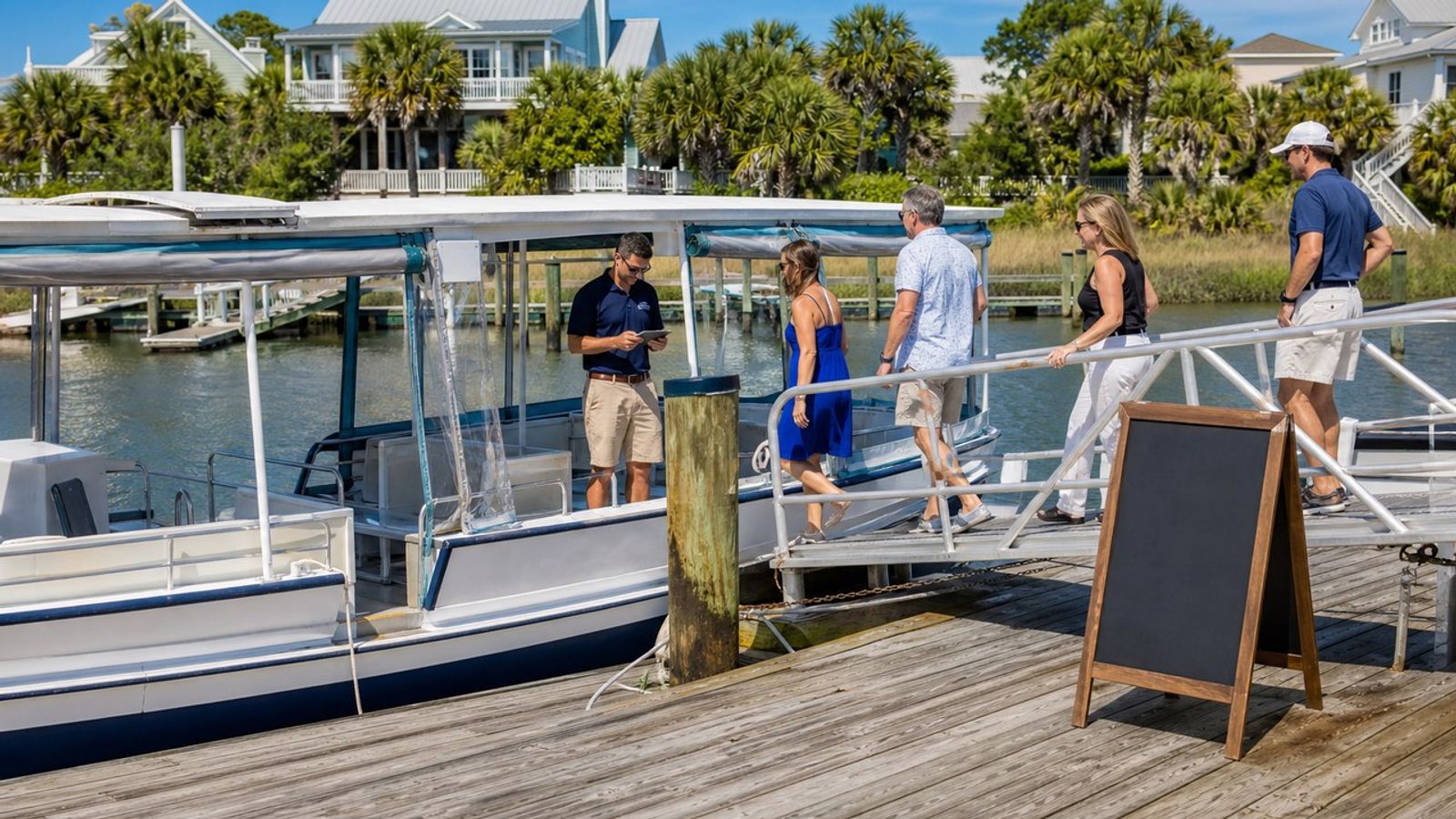
Consider a hypothetical sightseeing boat operator, with assumptions to replace with your own: a 48-passenger vessel, four daily departures, 120 operating days, a flat $42 fare today, and the load factors below. Seats offered per day: 192.
| Departure | Seats sold at $42 | New slot price | Seats sold after |
|---|---|---|---|
| 10:00 | 18 (38%) | $34 | 24 (50%) |
| 13:00 | 25 (52%) | $38 | 29 (60%) |
| 16:00 | 34 (71%) | $44 | 33 (69%) |
| 19:00 sunset | 46 (96%) | $54 | 42 (88%) |
| Total | 123 (64%) | 128 (67%) |
Daily revenue moves from $5,166 to $5,638, so yield per available seat rises from $26.91 to $29.36: $472 a day and $56,640 across the season, on five extra passengers.
Decompose the $472. The sunset departure went from $1,932 to $2,268: a $336 gain on four fewer passengers. The discounted 10:00 slot went from $756 to $816, a $60 gain on six extra passengers. The 13:00 added $52, the 16:00 $24.
Seventy-one percent of the improvement came from raising one price. The morning discount, the change operators are most comfortable making, delivered 13% of the gain while adding six people to service, clean and staff. Discounting feels safe because it is reversible and popular. It is also where the money is not.
Shift Versus Lift: Did You Discount Your Own Best Inventory?
One test separates a real gain from a reshuffle: if total seats sold stayed flat while your premium slot's load factor fell, you did not add demand. You moved it downhill and paid for the privilege. Check three numbers weekly against the same week last year or a held-out product:
- Total seats sold. Flat or down means no new demand.
- Premium slot load factor. A drop matched by a similar climb in the discounted slot is cannibalization.
- Yield per available seat. The only verdict that counts, and it can rise while passengers fall.
Every guest who slides from the $54 sunset departure to the $34 morning one costs $20. Six genuinely incremental morning passengers are worth $204; three cannibalized ones remove $162 from the slot you cannot expand.
Booking behavior tells you who is price-responsive. Arival's December 2025 report, Why Travelers Book Experiences in Advance (or Not), found 60% of travelers booked tour and attraction tickets at least three days ahead in 2025, and 20% of attraction buyers a month or more out, while roughly one in five bought on the day. Among early bookers, 33% cited better pricing; among late bookers, 41% cited flexibility and only 15% a better deal. Published differentials reach planners. Same-day discounting reaches people already coming.
Channel mix decides whether any of it is visible. Arival research reported by PhocusWire, from 5,664 operator responses collected August to November 2025, found walk-ups remain attractions' largest channel at 28%, while OTA share tripled from 8% in 2019 to 24% in 2025. If your differential never reaches that OTA connection, you have variable pricing for three quarters of your guests.
Guardrails: Price Paths, Ceilings, and the Asymmetry Nobody Budgets For
Guests react to the size and speed of a price change more than to the price itself, so manage the path a price travels, not its peak. FareHarbor's February 2026 guidance, Dynamic Pricing for Tours Without Hurting Long-Term Demand, states the asymmetry plainly: a large increase cuts conversion more than an equivalent decrease raises it, and reverting does not fully recover what was lost.
- Set a hard ceiling per product. FareHarbor's illustration caps a limited-supply tour at $99 and rises no more than $10 a day, rather than jumping $79 to $119 once a departure passes 75% full.
- Keep the base rate stable where supply is effectively unlimited. For an aquarium-style attraction, a $20 early slot against a $22 peak slot is a real signal and an invisible insult.
- Bridge season transitions. Moving $32 to $45 in one week reads as opportunism; a shoulder rate reads as a schedule. Cap adjustments for repeat and local guests.
- Stop the standing weekday promotion. A permanent Tuesday discount moves bookings to Tuesday. It does not create them.
- Reach for an add-on before a discount. Arival's September 2026 study of 2,550 US and European travelers, 3 in 4 Attraction Visitors Want Upsells, found nearly three in four interested in buying upsells. An add-on protects your reference price in a way a markdown does not.
- Keep every rule explainable in one sentence by the person at the window.
A Readiness Score to Run Before You Turn Any Rule On
Score each item 0, 1 or 2. Six or more out of eight means move; below six, fix the gap first, because a rule built on bad data prices confidently and wrongly.
- Slot-level history. 0 = daily totals only. 1 = one season by slot. 2 = two or more seasons by slot and weekday.
- Net revenue by channel. 0 = gross only. 1 = commission known in aggregate. 2 = net revenue per booking.
- Price control in every channel. 0 = OTA rates set yearly. 1 = manual updates. 2 = slot rates push automatically everywhere you sell.
- A named owner. 0 = nobody. 1 = shared with marketing. 2 = one person reviewing yield per available seat weekly, overruled only by the GM.
Items 1 and 3 are gates: without slot-level history you are guessing at elasticity, and without channel control a quarter of your guests never see the experiment.
A 90-Day Rollout, and What Not to Price Dynamically
Change one variable at a time and keep a comparison group: a vendor's report on its own performance is not evidence.
Days 1 to 30, measure. Compute yield per available seat by slot and weekday for the last full season, pull no-show rates by slot, and reconcile net revenue by channel. Decide your ceiling and floor per product before anyone proposes a rule; a number is easier to hold to once written down.
Days 31 to 60, one change. Raise your single most constrained slot by one increment and leave everything else alone. Do not discount anything yet. Track total seats sold, that slot's load factor and yield per available seat weekly, and take another increment only if load holds.
Days 61 to 90, add the soft slot, then codify. Only now introduce a lower rate on the weakest slot, and watch the premium slot's load factor rather than the morning's. Then write the rules down: ceilings, floors, maximum daily change, who may override, and which products are excluded.
Keep these out of the rules entirely. Group bookings quoted months ahead on contract. Members and passholders, whose whole proposition is a known price. Accessibility and companion tickets. Allotments committed to an OTA at a contracted rate. And anything inside 24 hours for guests who already bought, where a visible drop becomes a refund request.
AI belongs in the forecast, not the final call. It is good at projecting a slot's booking curve from last season plus weather and event calendars, and at flagging a departure running behind its own pace. It is poor at judging whether a $12 differential reads as fair on a Saturday in July, which is a brand decision for someone who knows the market. AI enhances human judgment here rather than replacing it, the same division of labor that runs through AI in hospitality operations and pricing vacation rental inventory. Process first, technology second: a pricing engine pointed at a business that cannot measure yield per available seat will only find the wrong answer faster.
Frequently Asked Questions
How big should the gap be between my cheapest and most expensive time slot?
Start narrow. A 10% to 25% spread between your softest and most constrained slot moves planners without reading as two different products. Widen it only after a full season shows the premium slot holding its load factor. FareHarbor's guidance is that speed matters more than size, so get there in increments.Do I need dynamic pricing software, or is variable pricing enough?
For most operators under about 50,000 annual guests, variable pricing is enough, and it is what the majority who claim dynamic pricing actually run. Arival's November 2026 analysis found just 6% use true dynamic pricing. Software earns its cost only once you have more slots than a person can review weekly.Will OTAs accept different prices for different time slots?
Generally yes, if your booking system pushes slot-level rates and availability through the connection. The constraint is operational rather than contractual: rates set manually once a season go stale, and an OTA showing yesterday's price creates an argument at the window. Confirm this before designing any rules.Won't guests who paid more leave bad reviews?
It happens when an increase is large, sudden, or unexplainable. Guests accept a sunset departure costing more than a mid-morning one because the reason is obvious. They object to the same seat costing more because software noticed they were close to booking. Publish the differential and hold a ceiling.How long before I know whether slot pricing worked?
Four to six weeks gives a directional read on one slot; a full comparable season gives a verdict. Judge it on yield per available seat rather than total passengers, and compare against the same period last year. Weather and local events move volume enough that a two-week window tells you nothing.Ready to Price Your Capacity With Data?
Slot-level pricing is a measurement problem before it is a pricing problem, and most operators already have the data sitting unexamined in their booking system. ANtreliX is a strategy-first AI and business intelligence consultancy in North Myrtle Beach, South Carolina, working with attractions, tour operators and hospitality businesses locally and remotely to build the reporting first and the pricing rules second. Talk to ANtreliX to see what your capacity is really yielding, or see our case studies.